
Leading the High-Speed Interconnect Era: Tsingteng Micro Unveils THPU3212 High-Speed Interface Redriver Chip
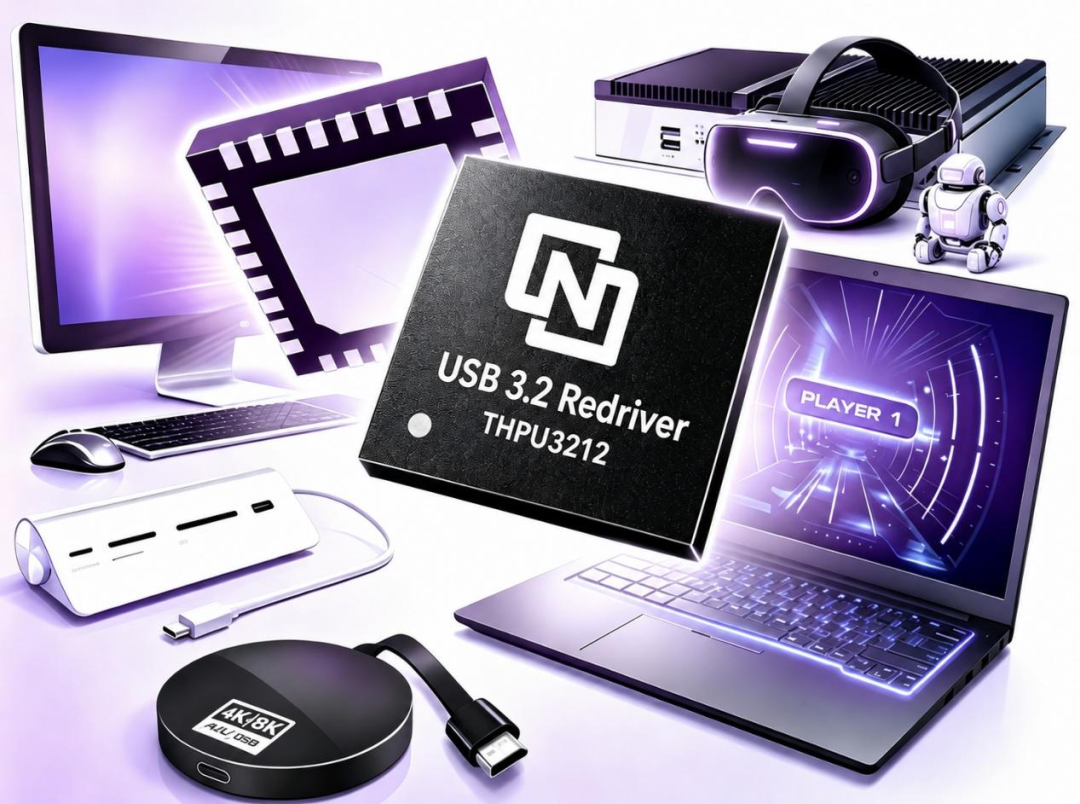
With the proliferation of 4K/8K ultra-high-definition video, the rise of AR/VR devices, and the continuously surging demand for high-speed, high-bandwidth, and low-latency data transmission in 5G wired communication and high-performance laptops, USB Type-C has become the universal cross-device interface standard. However, long PCB traces, connectors, and active cables introduce severe signal loss and inter-symbol interference (ISI). Routing constraints in end-product mechanical design leave conventional redriver chips struggling with inadequate equalization capability, relatively high power consumption, limited forward protocol compatibility, and supply chain instability.
Against this industry backdrop, Tsingteng Micro—leveraging its proprietary analog front-end and signal equalization technologies—has officially launched the THPU3212: a 4-channel linear USB 3.2 / DisplayPort™ 2.1 redriver high-speed interface chip. Featuring four core advantages—superior equalization performance, ultra-low power consumption, full protocol compatibility, and industrial-grade wide-temperature operation—the THPU3212 breaks the technological dominance of overseas suppliers and delivers a domestically developed, high-performance high-speed interconnect solution for consumer electronics, industrial communications, VR, and AR end devices.
1. Core Specifications and Parameters: End-to-End Coverage of High-Speed Interconnect Scenarios
The THPU3212 is a high-performance 4-channel linear redriver chip engineered specifically to resolve signal integrity challenges on the USB Type-C interface at high data rates. It fully complies with the USB 3.2 Gen 2 × 2 (2 × 10 Gbps) specification, maintains backward compatibility with USB 3.2 Gen 1, and forward-supports DisplayPort™ 2.1 Alternate Mode (UHBR10), delivering robust support for next-generation ultra-high-definition displays.
Deployed between the host SoC and the USB-C port, the THPU3212 effectively compensates for inter-symbol interference (ISI) introduced by PCB traces, connectors, and cables—significantly restoring eye diagram quality and substantially extending the transmission distance of high-speed signals. This ensures stable, error-free data transfer even in complex system environments.
Core Technical Advantages: Redefining the Performance Benchmark
The THPU3212 represents both an evolutionary advancement over prior generations and a major breakthrough across multiple critical performance metrics.
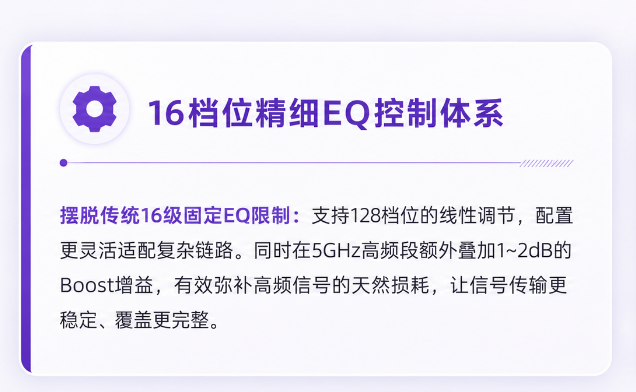
01 The THPU3212 supports 16-step high-frequency linear equalization plus 4-step DC gain adjustment. Low-frequency equalization, high-frequency gain, and bandwidth can be independently trimmed via eFuse. Its typical equalization gain at 5 GHz is 12.5 dB, with an additional 1–2 dB of high-frequency boost available. This superior high-frequency compensation capability outperforms competing solutions and accommodates FR4 PCB traces exceeding 15 inches in length—maintaining excellent eye diagram quality and jitter performance across extended channel lengths and significantly enhancing system design flexibility.
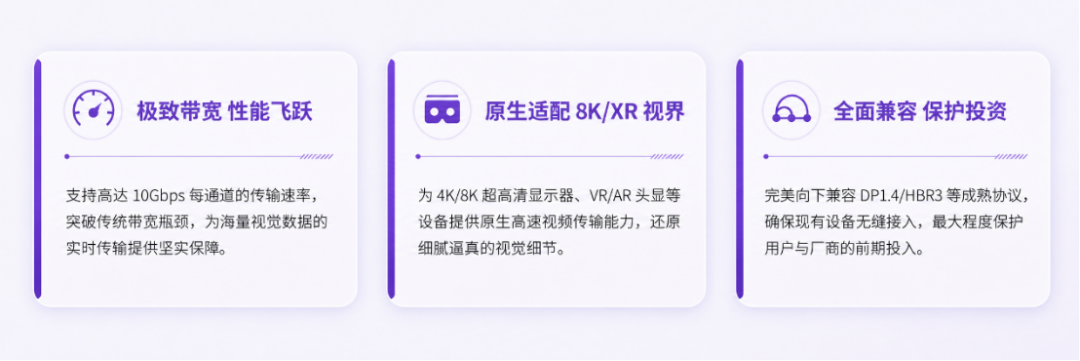
02 Forward-looking support for the DisplayPort™ 2.1 display protocol—directly targeting the 8K era. In display applications, the THPU3212 demonstrates exceptional foresight: it supports DP 1.4 / HBR3 and, more critically, fully complies with the DP 2.1 UHBR10 specification. Devices integrating the THPU3212 thus enable native, high-speed video transport for next-generation 4K/8K ultra-high-definition monitors and VR/AR headsets—serving as a foundational enabler for the next visual experience revolution.
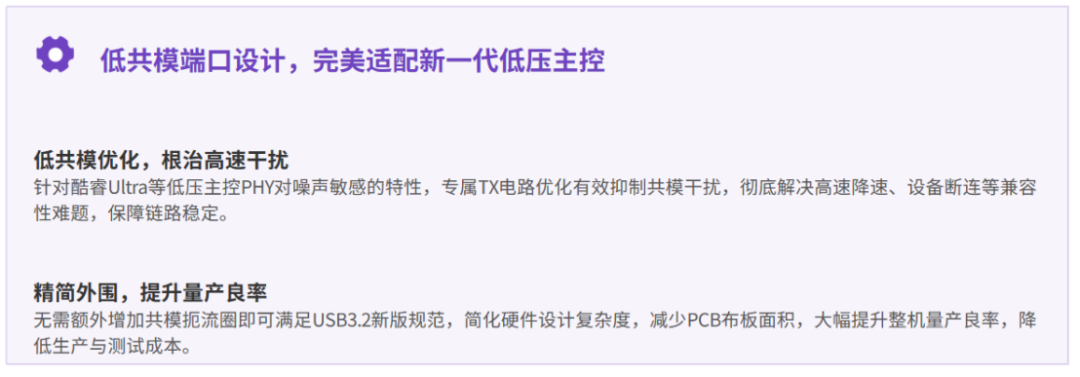
03 Tsingteng Micro’s commitment to independent R&D: The THPU3212 implements the company’s proprietary linear redriver architecture, featuring dedicated low-common-mode circuitry on its high-speed input and output ports—fully satisfying the latest USB 3.2 specification requirements for TX-level transitions.
New-generation low-voltage CPUs integrate PHYs highly sensitive to high-speed signal noise. Conventional redriver chips generate common-mode interference during TX-level transitions—potentially triggering link speed downgrades or device disconnections. The THPU3212 applies dedicated low-common-mode optimization to its high-speed ports and fully complies with the updated USB 3.2 TX transition specification. When paired with low-voltage controllers such as Intel Core Ultra or integrated hubs, the link remains stable without requiring additional external filtering components—enhancing overall unit manufacturing yield.
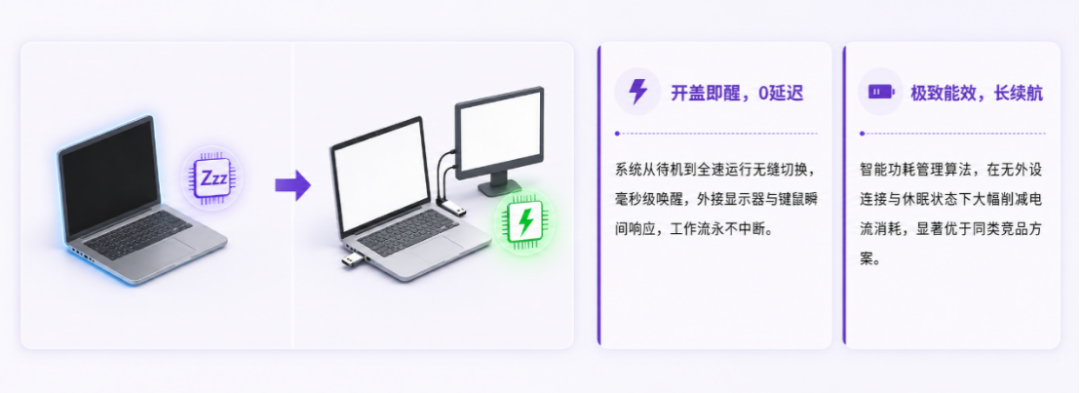
04 The THPU3212 operates from a single 3.3 V supply, with power metrics that benchmark—and exceed—industry standards. It is fully compliant with Microsoft’s Modern Standby specification. The chip enables ultra-low-power link retention during system sleep and achieves millisecond wake-up upon lid opening—ensuring instantaneous responsiveness from displays, keyboards, mice, and peripherals. This eliminates the multi-second latency associated with traditional sleep modes, seamlessly balancing extended battery life with a fluid user experience.
2. Significantly Leading Core Performance, Empowering the Internet of Everything
Tsingteng Micro has established a fully integrated USB/DisplayPort™ automated test laboratory, performing comprehensive, full-specification reliability validation using professional-grade instrumentation. Rigorous standardized testing ensures proven reliability and readiness for high-volume production.
In real-world testing and parameter benchmarking, the Tsingteng Micro THPU3212 demonstrated compelling differentiation—with multiple key performance metrics significantly surpassing those of mainstream industry competitors:
➢ Measured Performance Comparison
| Key Feature | THPU3212 (Tsingteng Micro) | Leading Benchmark Product (Competitor) | Tsingteng Micro Advantage |
|---|---|---|---|
| Maximum Linear Equalization @ 5 GHz | 12.5 dB | 10.5 dB | Greater high-frequency compensation margin—effectively improving far-end eye diagram quality. |
| Video Protocol Support | DP 1.4 / DP 2.1 (UHBR10) | DP 1.4 / DP 2.1 (HBR3) | Enables future ultra-high-definition displays—directly enabling the 4K/8K era. |
➢ Measured Output Eye Diagram of a Link Featuring the THPU3212 Redriver
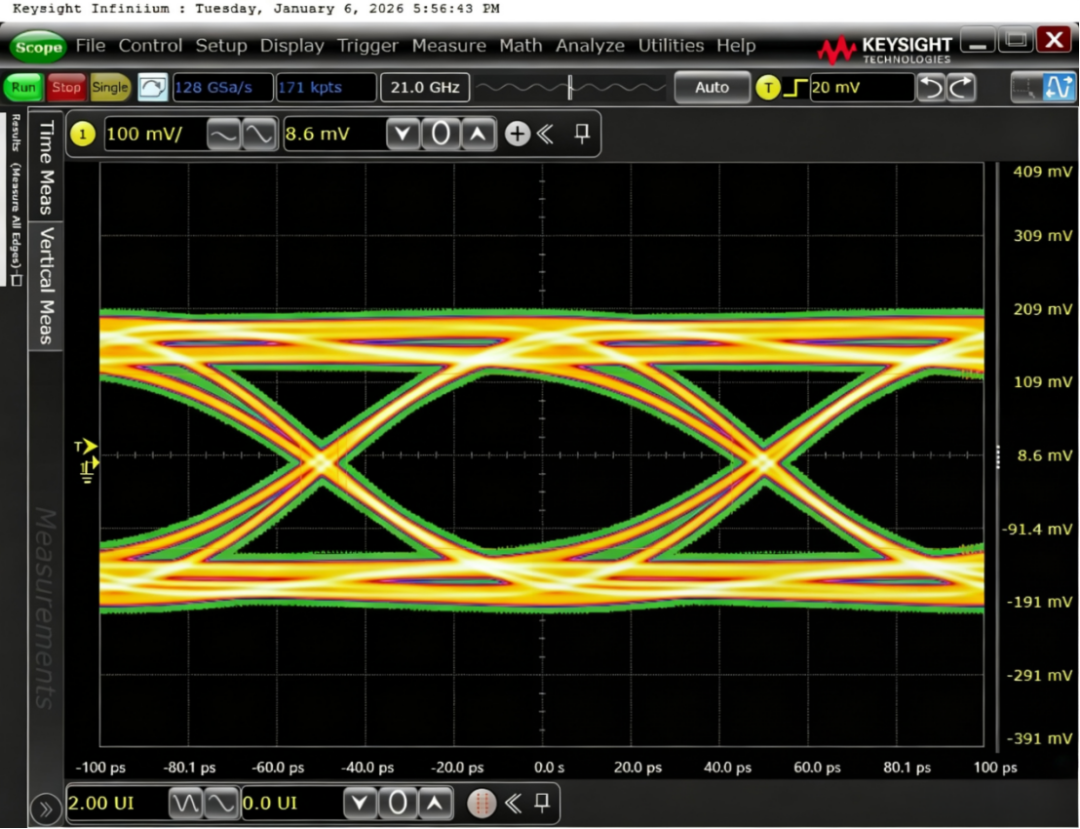
Test results clearly demonstrate that the THPU3212 effectively mitigates inter-symbol interference: the eye opening widens significantly, signal jitter is substantially reduced, and error-free transmission is maintained across long distances, multi-layer PCBs, and multiple connectors—a major leap forward in link stability.
3. Diverse Application Scenarios: Covering Both Consumer and Industrial Markets
Leveraging dual-protocol support (USB 3.2 + DisplayPort™ 2.1), industrial-grade wide-temperature operation, and low-power drive capability, the THPU3212 is optimized for four categories of end products:
1. Computing Devices: Thin-and-light laptops, gaming laptops, tablets, and desktop motherboards with integrated USB-C high-speed ports—addressing signal attenuation caused by internal chassis-level long PCB traces;
2. Office Peripherals: Multi-port docking stations, 4K/8K active Type-C cables, and desktop expansion docks;
3. Display and XR Devices: Professional design monitors, smart 8K TVs, VR/AR all-in-one units, and head-mounted displays;
4. Industrial and Communication Equipment: 5G base stations, industrial high-speed cameras, autonomous robotics systems, and data acquisition servers.
In Closing
Facing the next wave of high-speed interconnect innovation—driven by 8K ultra-high-definition video, AR/VR, high-performance computing, and the industrial Internet—the Tsingteng Micro THPU3212 redefines the performance benchmark for high-speed interface redrivers.